Reduce RTO and COD losses for D2C brands in India
Every order that comes back costs you shipping twice, packaging and the ad spend that brought it in. We find where your returns to origin come from, by payment mode, pin code, product and ad, then fix them in order: checks before a COD order ships, easier prepaid payment, rules for high-risk pin codes, and ads that learn from delivered orders.
Works best for Indian D2C brands shipping a few hundred orders a month or more, with a large share on cash on delivery, selling on their own website through Shopify or a similar store.
CLICKPOST RTO DATA (BRANDS WITH 1,000+ COD ORDERS), MEESHO'S OFFER DOCUMENT AND NPCI. NO OFFICIAL NATIONAL RTO FIGURE EXISTS. SOURCES AT THE FOOT OF THE PAGE.
Where RTO comes from
RTO, or return to origin, is an order the courier couldn't deliver and sent back to you. It usually has a handful of causes, and each one has a different fix. We sort your returned orders into these groups before changing anything.
| What it looks like | What usually fixes it | Where we see it | |
|---|---|---|---|
| Impulse COD orders | The buyer ordered on a whim and refuses the parcel at the door | A confirmation message before shipping, and an easy prepaid option | Late-night orders, first-time buyers, low prices |
| Bad addresses | Missing flat numbers, wrong pin codes, landmarks the courier can't find | Pin-code lookup and address checks at checkout, and a request to correct it before the label is printed | New pin codes, typed-in addresses |
| Unreachable buyers | Phone switched off or wrong; the courier marks "customer not available" | Phone checks at checkout, and a call or message as soon as delivery fails | Orders with no confirmed number |
| Slow delivery | The buyer changed their mind or bought elsewhere while waiting | Faster couriers for slow lanes, honest delivery dates at checkout | Smaller cities, long-distance lanes |
| Ad mismatch | The parcel doesn't match what the ad promised, or the price feels high at the door | Ads and product pages that show the real product and price | Specific ads, creatives or offers |
| Courier gaps | Delivery attempts marked as failed that may never have happened | Checking failed-delivery reasons with the buyer, then routing away from weak couriers | One courier or one area |
On ClickPost's network, across all payment modes, 12.0% of Tier 3 orders ended as RTO against 6.6% from metros in October and November 2025. Where you ship matters almost as much as how buyers pay.
The order we fix things in
We start with the fixes that cost least and touch every order, and leave pin-code rules for later, once there's data behind them.
- WEEK 1
Measure RTO properly
Your last three to six months of orders, split by payment mode, pin code, product, courier and the ad or campaign that brought each order in.
- WEEKS 1–2
Fix addresses and phone numbers at checkout
Pin-code lookup, required house and street fields, and a check that the phone number is real.
- WEEKS 2–3
Confirm COD orders before they ship
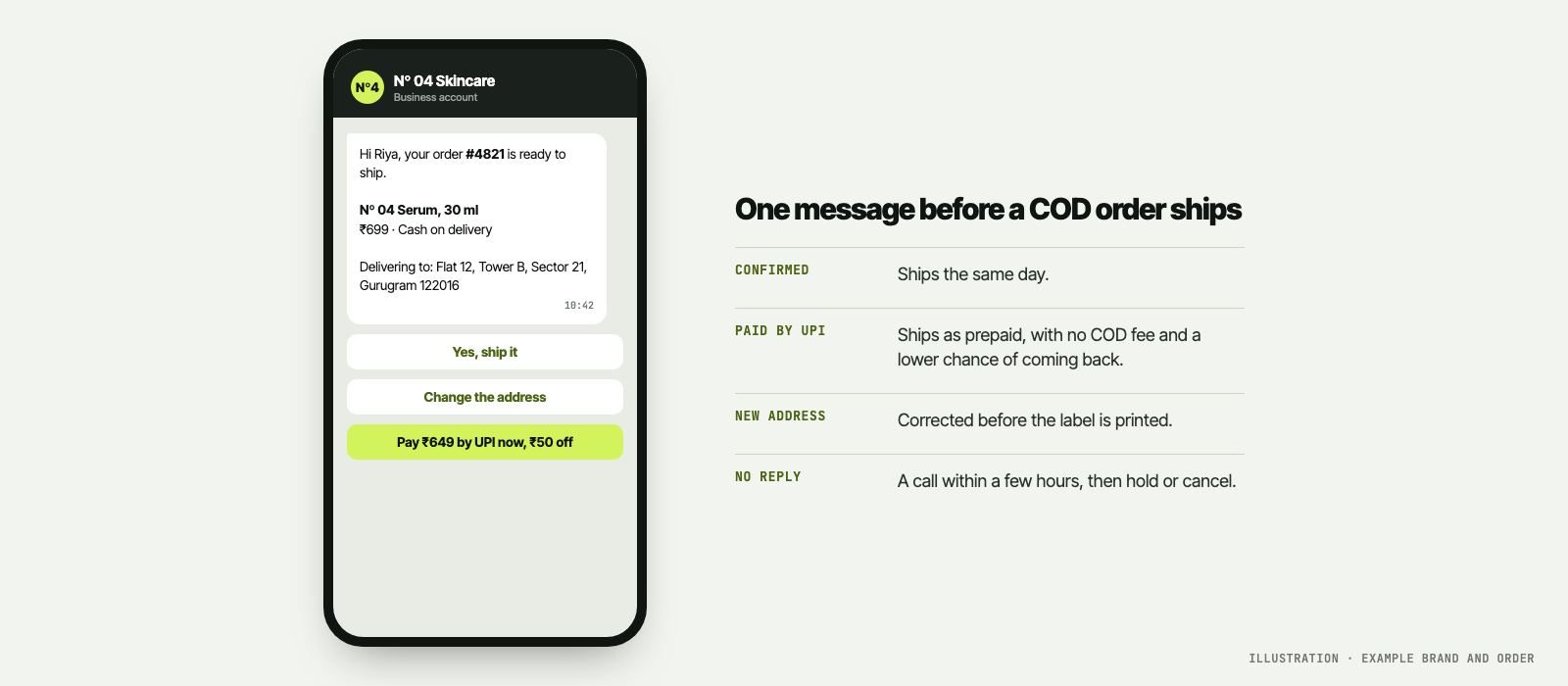
A WhatsApp or call confirmation for every cash-on-delivery order, with options to correct the address or switch to UPI.
- WEEKS 3–4
Make prepaid the easy choice
UPI shown first at checkout, a small prepaid discount where your margin allows, and part-payment options for higher order values.
- MONTH 2
Set rules by pin code and courier
Where RTO stays high, ask for a small advance or prepaid only, and move slow lanes to faster couriers.
- ONGOING
Tell your ads which orders arrived
Send delivered orders back to Meta and Google so they find more buyers who accept their parcels.
We track these three numbers every week.
- RTO by payment mode
- COD and prepaid separately. A blended rate hides the problem, because it drops whenever the prepaid share rises.
- Prepaid share
- The share of orders paid before shipping. It's often the biggest single lever on blended RTO.
- Cost per delivered order
- Ad spend, shipping both ways and packaging, divided by orders that actually arrived. This is what RTO really does to your margin.
What we need to start
Most of this is already in your store and courier dashboards. The order export matters most, because every fix is planned from it.
Data and access
- An order export for three to six monthswith pin code, payment mode, delivery status, courier and order source
- Failed-delivery reports from your couriers or shipping platform
- Access to your store's checkout settingsShopify or similar
- A WhatsApp Business account, or a calling teamfor COD confirmations
- Your Meta and Google ad accountsso we can tie RTO to campaigns and send delivered orders back
- Your margin per product
Where brands lose the most
- Shipping COD orders unconfirmedImpulse orders go out and come back two weeks later.
- Hiding UPI behind cash on deliveryBuyers pick the first option they see.
- One rule for every pin codeA few pin codes often cause a large share of returns.
- Ads judged on orders placedA campaign full of COD orders that come back looks cheap in Ads Manager.
- No follow-up after a failed deliveryA quick call often saves the order before it's sent back.
- Blocking COD everywhere at onceIt cuts returns and sales together. Use it only where the numbers say so.

What RTO costs you
The cost of a returned order is spread across your courier invoice, warehouse and ad account, so it's easy to underestimate. These are the parts, and where to find each one.
| Cost | What it is |
|---|---|
| Forward shipping | Paid to send the parcel out, delivered or notYour courier invoice |
| Return shipping | Charged again to bring it back to your warehouseYour courier invoice |
| COD charges | Some couriers and shipping platforms charge a fee on cash-on-delivery ordersYour shipping contract |
| Packaging and handling | Box, filler, label and the time to pack, unpack and restockYour warehouse costs |
| Damaged or expired stock | Returned items that can't be sold againYour warehouse records |
| Ad spend | What it cost to win that order in the first place, now spent on a sale that didn't happenYour ad accounts |
| Stock in transit | Units tied up for one to three weeks while a parcel travels out and backHarder to price |
Work out your monthly RTO cost
The numbers filled in are examples. Replace them with yours from the last three months.
Damaged stock, COD fees and stock in transit aren't included, so the real cost is usually higher. This is a planning tool; check the result against your own courier invoices.
What we do to bring RTO down
RTO sits between your ads, your checkout and your couriers, so we work on all three and report on one number: cost per delivered order.
Find where returns come from
An analysis of your orders by payment mode, pin code, product, courier and campaign, with the few groups that cause most of your returns named.
Tidy up checkout
Pin-code lookup, address and phone checks, UPI shown first, and clear delivery dates, set up in your existing store and checkout tools.
Set up COD confirmation
WhatsApp messages or a call script for every cash-on-delivery order, with a one-tap switch to UPI and an address fix before shipping.
Write pin-code and courier rules
Advance payment or prepaid-only where the data supports it, and slow lanes moved to faster couriers, reviewed every month.
Point your ads at delivered orders
Delivered-order data sent back to Meta and Google, campaigns judged on cost per delivered order, and high-RTO audiences and placements cut back.
Report every week
RTO by payment mode, prepaid share and cost per delivered order, with the changes made that week and what they did.
How we move COD buyers to prepaid
Many buyers choose cash on delivery out of habit or doubt about a new brand. Small changes at checkout and after the order can move some of them to UPI. We test each change against your conversion rate.
- AT CHECKOUT
UPI first, with the amount and any prepaid saving shown on the button. Cash on delivery stays available, just lower down.
- BIGGER ORDERS
A small advance by UPI with the rest on delivery. The buyer has paid something, so refusing the parcel costs them too.
- AFTER ORDERING
The confirmation message offers a UPI link with the same discount, before the label is printed.
- PRODUCT PAGE
Reviews, delivery dates and a clear returns policy, so paying in advance feels safe for a first-time buyer.
How we judge it. Prepaid share and RTO by payment mode, week on week, next to conversion rate. If conversion drops more than RTO saves, we roll the change back.

Mistakes we see often
- Looking only at the blended RTO rateIt improves whenever prepaid share rises, even if COD returns get worse. Track COD and prepaid separately.
- Switching off COD for everyoneReturns fall, and so do orders. Restrict COD only where pin-code data shows it loses money.
- A prepaid discount bigger than a return costsWork out what one return costs you first, then set the discount below it.
- Confirming orders after they've shippedThe message has to go out before the label is printed, or it can't stop a bad order.
- Judging ads on orders placedA campaign with cheap orders and a high return rate can cost more per delivered order than a pricier one.
- Ignoring failed-delivery reasonsSome "customer unavailable" attempts never happened. Ask the buyer before you accept the return.
- Treating every pin code the sameA small set of pin codes often drives a large share of returns. Rules work best when they're narrow.
- Fixing RTO once and moving onPin codes, couriers and ad audiences change every month. Review the numbers weekly.
How we work together
We agree a fixed fee before we start. Courier, payment gateway and messaging costs are paid to those providers directly, not through us.
RTO audit
For brands that want to know where their returns come from first.
- Order analysis by payment mode, pin code, product, courier and campaign
- Your cost per delivered order, worked out
- Checkout review with the changes to make
- A ranked list of fixes with expected effect
RTO reduction and growth
The audit, then the fixes, run alongside your ads.
- Checkout and COD confirmation set up
- Pin-code and courier rules, reviewed monthly
- Meta and Google ads judged on delivered orders
- Prepaid offers tested and adjusted
- A weekly report on RTO, prepaid share and cost per delivered order
Results from our D2C work
These come from D2C ad accounts and websites we've worked on. Each one has a case study with the details.
Common questions
What is RTO in ecommerce?
RTO stands for return to origin: an order the courier couldn't deliver, which is sent back to your warehouse. The buyer may have refused it, been unreachable or given a wrong address. You usually pay shipping both ways, and the ad spend that won the order is lost.
What is a normal RTO rate in India?
There's no official national figure, and published numbers measure different things. On ClickPost's FY2026 D2C network, 37.51% of COD orders ended as RTO against 5.28% of prepaid orders. Meesho's offer document shows 77.7% of its COD orders delivered in FY2025, against 97.2% of prepaid. Your own rate by payment mode is the number to track.
Why are COD orders returned so much more often?
A cash-on-delivery buyer hasn't paid anything, so refusing the parcel costs them nothing. Impulse orders, doubts about a new brand, wrong addresses and unreachable phone numbers all show up more often in COD orders.
Should we stop offering cash on delivery?
Usually not everywhere. Many Indian buyers still prefer it, especially for a brand they haven't bought from before, so switching it off can cut sales as much as returns. Confirm COD orders, make prepaid easier, and restrict COD only in the pin codes where the numbers show it loses money.
How do we get more customers to pay by UPI?
Show UPI first at checkout, put any prepaid saving on the payment button, offer a small advance with the rest on delivery for higher order values, and include a UPI link in the COD confirmation message. Build trust on the product page with reviews, delivery dates and a clear returns policy.
How big should a prepaid discount be?
Smaller than what one returned order costs you, multiplied by how much less often prepaid orders come back. The calculator on this page works out the cost of a return from your shipping, packaging and ad costs, so you can set the discount below it.
Does WhatsApp confirmation for COD orders work?
It catches orders that were placed on a whim or with a wrong address before they ship, which is when stopping them is cheapest. It also gives the buyer a moment to switch to UPI. We measure it by comparing RTO on confirmed orders with orders that weren't confirmed.
Can ads be set up to bring in fewer returns?
Yes. When Meta and Google only see orders placed, they look for more people who place orders, including ones who refuse delivery. Sending delivered orders back and judging campaigns on cost per delivered order shifts spend towards buyers who accept their parcels.
How long does it take to bring RTO down?
The checkout and confirmation changes can be live within two to three weeks, and you'll see their effect on orders shipped after that. Pin-code rules and ad changes need a month or two of data. How far RTO falls depends on your categories, regions and current setup.
Can you guarantee a lower RTO rate?
No. Buyers, couriers and regions all play a part we don't control. We measure where your returns come from, make the changes with the best chance of working, and report the results every week.
Talk to us about your RTO
Tell us how many orders you ship and how many come back. On the call we'll look at where your returns are likely coming from and which fix to start with.
Useful to have ready:
- Monthly orders and your COD share
- Your RTO rate, split by COD and prepaid if you have it
- Your store platform and shipping partner
Prefer to pick a time? Open the booking page