Ad creative testing for D2C brands on Meta
We find out which ads sell for your brand by changing one thing at a time. Each test looks at an angle, a hook, a format or an offer, runs inside your live campaign on a small share of the budget, and is judged on what a sale costs. We write down why each winner won, so every new batch of ads starts from what your customers have already responded to.
Works best for D2C brands already running Meta ads every month, with purchases tracked through the Meta pixel and Conversions API, and a product range with room for new angles.
FROM META'S BUSINESS HELP CENTER, CHECKED 26 NOVEMBER 2026. LINKS AT THE FOOT OF THE PAGE.
What we test, from biggest effect to smallest
The angle you lead with usually moves results more than a new headline does, so we test it first. Each row below is one test, and only that row changes. The examples are for a face serum.
| What changes | Example versions | What decides it | |
|---|---|---|---|
| Angle | The reason to buy that the ad leads with | Fades dark spots · made for humid weather · formulated with a dermatologist | Cost per purchase |
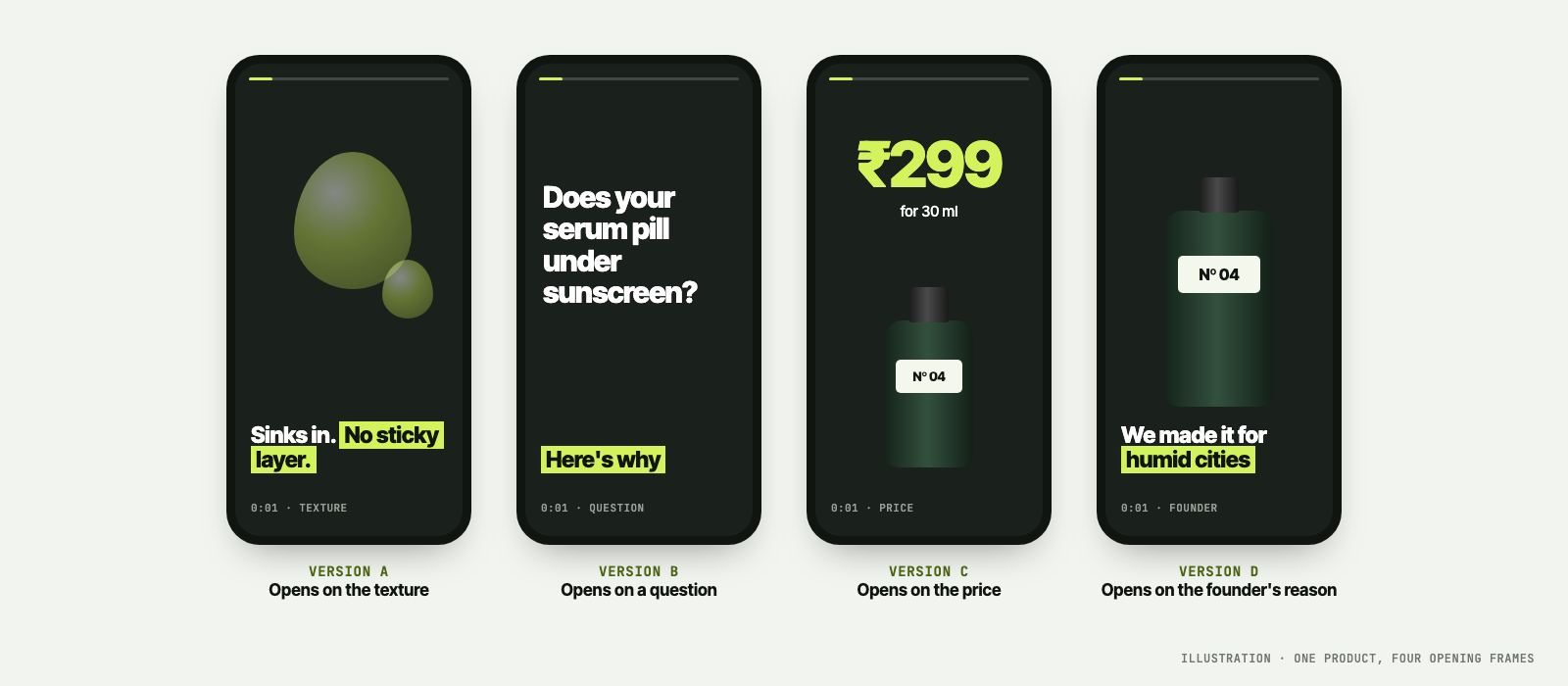
| Hook | The first three seconds of a video, or the headline on a static | Open on the texture · on a question · on the price | Hook rate, then cost per purchase |
| Format | How the same angle is shown | Static · customer-style video · product demo · founder to camera · carousel | Cost per purchase and hold rate |
| Offer | What the buyer gets for ordering now | Free shipping · a mini with the full size · ₹100 off the first order | Cost per purchase and order value |
| Copy | Primary text and headline under the same visual | Two lines · a short review quote · a longer how-to-use note | Click-through rate, checked against purchases |
| Landing page | Where the click goes | Product page · a page built for this angle | Conversion rate and cost per purchase |
Changing two of these at once is the most common reason a test can't be read. If the new ad wins, nobody can say whether it was the hook or the offer, and the next brief is a guess again.
How one test runs
A test takes about two weeks from brief to result for most accounts we work with. The calculator further down estimates it for your budget.
- DAY 0
Write the brief
The one thing being tested, what we expect to win and why, and the number that will decide it. Most angles come from your reviews and customer questions.
- DAYS 1–4
Make three to five versions
Same product, same offer, same landing page. Only the tested element changes, and the versions are different enough to give a clear answer.
- DAYS 5–14
Run them inside the live campaign
We use Meta's creative test in your existing campaign, on a set share of its budget, and leave it alone while it runs.
- DAY 15
Read the result
Hook rate first, then cost per purchase. A small gap over a handful of sales is a tie, and we say so.
- AFTER
Keep the winner and log the reason
The winning ad keeps running in the main campaign. Why it won goes into a shared test log and becomes the next brief.
We read the results in this order.
- Hook rate
- Three-second video plays divided by impressions. It shows whether the opening stopped the scroll. We compare it with your account's own average, since a good number differs by category.
- Hold rate
- ThruPlays divided by three-second plays. It shows whether the middle of the video kept people watching.
- Cost per purchase
- What each sale cost, next to your current best ads. This decides the test. A cheap click that doesn't buy is still expensive.
What we need before the first test
None of this takes long to pull together. Tracking is where accounts most often need fixing, because a test judged on purchases needs every purchase recorded.
From your side
- Margin per productso we know the most a sale can cost before it loses money
- Your current best ads and their numbersthe control every new version has to beat
- Customer reviews and support questionswhere most of the angles we test come from
- Product samples or footage you already have
- The Meta pixel and Conversions API sending purchaseswe check this in the first week
- Access to your Meta ad account and Business Manager
Where tests usually go wrong
- Several changes in one adYou can't tell which change made the difference.
- Versions that look almost the sameTiny differences give tiny, unreadable gaps.
- Too little budget per versionA version with four purchases hasn't been tested yet.
- Calling it on day twoEarly numbers swing a lot. Wait for enough purchases.
- Editing ads while the test runsMeta says edits during learning reset it and delay optimisation.
- Judging on clicks aloneClick-through rate is a clue. Cost per purchase is the answer.

What a fair test costs
A test needs enough purchases on each version to tell them apart, and that sets the budget. Meta's own rules for creative tests are below, then a calculator for your numbers.
| Rule | What Meta says |
|---|---|
| Versions per test | 2 to 7 copies of an existing ad, each with its own creativeMeta Business Help Center |
| Where it runs | Inside an existing campaign, so winning ads keep running afterwards with the campaign's learnings intactMeta Business Help Center |
| Bid strategy | Highest volume only. Campaigns on other bid strategies have to switch to run a test.Meta Business Help Center |
| Budget | You choose the share of the campaign or ad set budget. Meta suggests no more than 20%.Meta Business Help Center |
| Picking a winner | You choose the duration and the comparison metric. Results name top performers but don't include a confidence level.Meta Business Help Center |
| After the test | Nothing changes automatically. Test ads keep running on the original budget until you turn them off.Meta Business Help Center |
| Learning phase | An ad set usually leaves learning after about 50 results in the week after its last significant edit.Meta Business Help Center |
Work out your test budget
Use your own cost per purchase and daily budget. "Purchases per version" is how much evidence you want before deciding; more gives a steadier answer.
New versions rarely cost exactly what your current ads do, so treat this as a planning estimate. Meta suggests keeping test ads to 20% of the budget or less.
What we do in creative testing
We plan the tests, make the ads and read the results, so the same team that sees the numbers writes the next brief.
Find the angles worth testing
We read your reviews, support tickets, competitor ads and search terms, and turn them into a ranked list of angles with the reason behind each one.
Write the scripts and hooks
Several openings for each angle, written for the first three seconds with the sound off, plus primary text and headlines.
Make the ads
Statics, customer-style videos, product demos, founder videos, carousels and motion graphics, cut to 9:16, 4:5 and 1:1.
Set up and run the tests
Meta creative tests inside your live campaigns, with the budget share, duration and deciding metric agreed before launch.
Read the results honestly
Hook rate, hold rate and cost per purchase for every version, with clear wins, ties and losses called as they are.
Keep a test log
One shared document with every test, what won and why. After a few months it shows which angles and formats work for your customers.
How we read a test and what happens next
Meta's creative test report names top performers but gives no confidence level, so we look at the size of the gap and the number of purchases behind it before we call anything.
- HOOK RATE
If an opening stops far fewer people than your average, it's replaced, whatever its other numbers say.
- HOLD AND CLICKS
These explain why a version did well or badly. They don't decide the test on their own.
- COST PER PURCHASE
This decides it. We call a winner when it's clearly cheaper over enough purchases, and a tie when the gap is small.
- NEXT BRIEF
The winning element stays and the next test changes something else. A winning hook gets tested in new formats, for example.
When we make new ads. On a schedule, before results drop. Meta marks an ad "Creative limited" once its cost per result rises above your past ads, and "Creative fatigue" at twice or more. By then you've already been paying more for a while.

Mistakes we see often
- Testing several changes in one adIf the new ad wins, you don't know why. Change one thing per test.
- Ending the test after two daysEarly numbers swing a lot. Wait until each version has enough purchases to compare.
- Putting most of the budget on testsMeta suggests no more than 20% on test ads. The rest keeps your proven ads selling.
- Switching off the old winner straight awayMeta's own fatigue guidance says keeping the original ad active may get you more results. Let the new ad earn its place.
- Editing ads in the middle of a testMeta says edits during the learning phase reset learning. Set the test up properly, then leave it.
- Picking the winner on click-through rateClicks from people who don't buy still cost money. Decide on cost per purchase.
- Making new ads only once results dropBy the time Meta shows "Creative fatigue", each result costs twice what your past ads did. Test on a schedule.
- Not writing down why a version wonWithout a log, every new brief starts from scratch and the same losing ideas get tested twice.
How we work together
We agree a fixed fee before we start. Your ad spend is paid to Meta directly, not through us.
Creative testing sprint
For brands that want to see the method on one round of tests first.
- Angle research from your reviews and competitors
- Tracking check before anything runs
- Three to five new versions for one test
- Test set-up, reading and a written result
- The brief for the next test
Monthly creative testing
Everything in the sprint, run every month, with the ads made by our team.
- New tests every month on angles, hooks, formats and offers
- Statics, videos and carousels in every placement size
- A running test log your team can read
- Winners moved into your main campaigns
- A monthly report on cost per purchase by angle and format
Results from our D2C work
These come from D2C ad accounts and websites we've worked on. Each one has a case study with the details.
Common questions
What is ad creative testing?
Running a few versions of an ad side by side, with one element changed, to find out which version gets sales at a lower cost. The element can be the angle, the opening hook, the format, the offer, the copy or the landing page. Done regularly, it tells you which messages and formats your customers respond to.
How many creatives should we test at once?
Usually three to five. Meta's creative test allows two to seven versions, but every version you add splits the test budget further, so each one takes longer to collect enough purchases. Fewer, clearly different versions give an answer sooner.
How long should a creative test run?
Until each version has enough purchases to compare, which for most accounts we work with is one to three weeks. It depends on your cost per purchase and how much budget goes to the test. The calculator on this page estimates it for your numbers.
How much budget does a creative test need?
Roughly your cost per purchase, times the number of versions, times the purchases you want per version. At ₹600 a purchase, four versions and 20 purchases each, that's about ₹48,000. Meta suggests putting no more than 20% of the campaign budget on test ads, which sets how many days it takes.
Should we use Meta's creative test or an A/B test?
Use the creative test to try new ads in a campaign that's already working, because the test ads run inside it and keep its learnings. Its results name top performers without a confidence level. For bigger decisions, such as changing your main offer across the account, we set up a separate A/B test in Meta's Experiments.
What is a hook rate, and what's a good one?
Hook rate is three-second video plays divided by impressions: the share of people who stopped scrolling. A good number varies a lot by category and placement, so we compare each new version with your own account's average rather than an industry figure.
Will testing hurt our main campaign?
It shouldn't, if the test gets a small share of the budget. Meta's creative test spends the share you choose, and Meta suggests 20% or less. We also avoid editing ads while a test runs, since Meta says edits during the learning phase reset learning.
How do we know when an ad is tired?
Meta shows it in the Delivery column. An ad is marked "Creative limited" when its cost per result is higher than your past ads, and "Creative fatigue" when it's twice as high or more. We plan new tests before an ad gets there.
Do you make the ads as well?
Yes. Our team writes and makes statics, customer-style videos, product demos, founder videos, carousels and motion graphics. If you already work with a production team or creators, we can write the briefs and test what they make.
Can you guarantee a winning ad?
No. Some tests end in a tie, and a few find that the current ad is still the best one. Both are useful results, because they stop you spending on changes that wouldn't have helped.
Talk to us about creative testing
Tell us what you sell and how your Meta ads are doing. On the call we'll look at your current ads, suggest the first thing worth testing, and work out the budget it needs.
Useful to have ready:
- Your monthly Meta ad spend and cost per purchase
- Your best-selling products and their margins
- The ads that have worked best so far
Prefer to pick a time? Open the booking page